Home Comfort Guide: Nursery Temperature, AC Maintenance, and Seasonal Tips
Home Comfort Guide: Nursery Temperature, AC Maintenance, and Seasonal Tips
Reading time: 12 minutes
Picture this: It’s 2 a.m., your newborn is fussing, and you’re second-guessing every decision you’ve made about your home’s climate setup. Is it too warm? Too cold? Is the air conditioner running safely? These are the questions no parenting book fully prepares you for — but this guide will.
Whether you’re a first-time parent building out a nursery, a homeowner trying to cut AC costs heading into the warmer months of 2026, or simply someone who wants to optimize home comfort across every season, you’ve landed in the right place. We’ll walk through the science and practical realities of nursery temperature management, AC upkeep, and seasonal comfort strategies — with real examples, current data, and zero fluff.
The foundation of all of this starts with one small but powerful device: the thermostat. Understanding how to use it strategically — not just reactively — is the first step toward a genuinely comfortable home year-round.
Table of Contents
- Why Nursery Temperature Matters More Than You Think
- The Ideal Nursery Temperature Range in 2026
- AC Maintenance Essentials for Safe, Efficient Cooling
- Seasonal Home Comfort Tips: Room by Room
- Common Challenges and How to Overcome Them
- Data at a Glance: Temperature Comfort Benchmarks
- Frequently Asked Questions
- Your Home Comfort Action Plan: Start Tonight
Why Nursery Temperature Matters More Than You Think
Most new parents obsess over feeding schedules, sleep positions, and swaddle techniques — and rightly so. But ambient room temperature in a baby’s nursery is one of the most underrated safety and wellness factors in early childhood development. According to research published through the American Academy of Pediatrics, overheating is consistently linked to an increased risk of Sudden Infant Death Syndrome (SIDS). In 2026, SIDS prevention guidelines continue to emphasize temperature regulation alongside safe sleep surfaces and smoke-free environments.
Here’s the uncomfortable truth many parents discover late: babies cannot regulate their own body temperature effectively in the early months of life. Unlike adults who sweat or shiver in response to temperature shifts, newborns rely almost entirely on their environment and caregivers. A nursery that feels “comfortable” to an adult standing fully clothed may be dangerously warm for a swaddled infant lying still.
Consider the experience of Maya and James, a couple from Austin, Texas, who welcomed their daughter in early 2025. Their nursery shared a wall with a south-facing exterior, making it significantly warmer than the rest of the house throughout the afternoon. Despite setting their whole-home thermostat to 72°F, a nursery-specific thermometer revealed the room was regularly reaching 78–79°F during peak sun hours. Installing a blackout curtain and adding a small, targeted cooling unit transformed the space — and their daughter’s sleep quality improved measurably within a week.
The lesson? Your central thermostat reading is not always the temperature in your baby’s room. Microclimates within homes are more common than people realize, especially in 2026 when energy-efficient home designs and open-floor layouts can create surprising thermal variations.
The Ideal Nursery Temperature Range in 2026
What the Experts Recommend
The most widely cited recommendation from pediatric health organizations — including the AAP, the NHS in the UK, and SIDS prevention groups across Australia and Canada — places the ideal nursery temperature between 68°F and 72°F (20°C to 22°C). This range balances thermal comfort with safety, reducing the risk of both overheating and excessive cold stress on infants.
Some updated guidelines published in late 2025 have nuanced this recommendation slightly, noting that nighttime temperatures can sit toward the cooler end of the range (68–70°F), while daytime nap environments can comfortably reach 71–72°F. This mirrors natural circadian rhythm support — slightly cooler environments promote deeper, more restorative sleep cycles even in infants.
Dr. Rachel Kim, a pediatric sleep consultant based in Seattle, put it plainly in a 2025 interview: “Parents tend to overbundle their babies because they’re projecting their own comfort preferences. A good rule of thumb: dress your baby in one more layer than you’d wear, then let the room do the work at the right temperature.”
How to Measure and Monitor Nursery Temperature Accurately
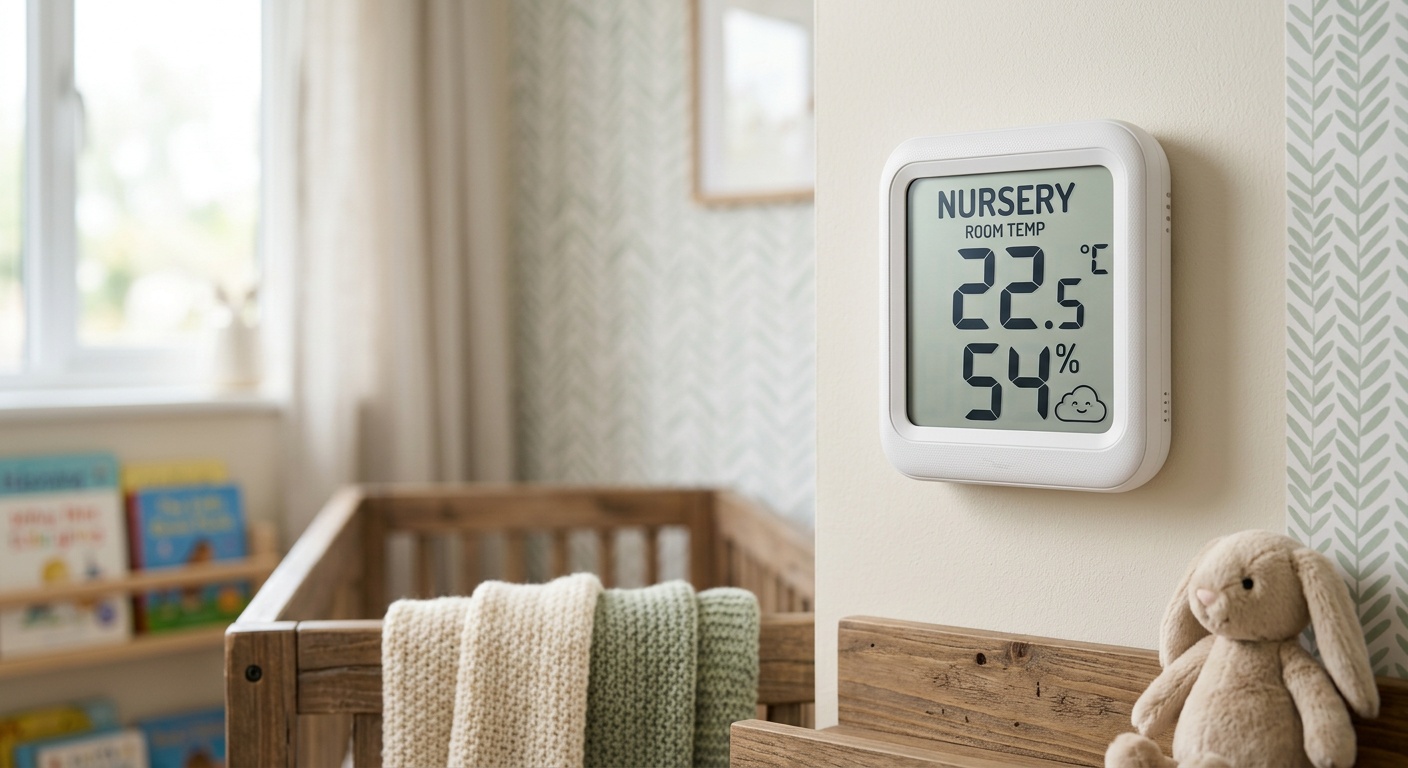
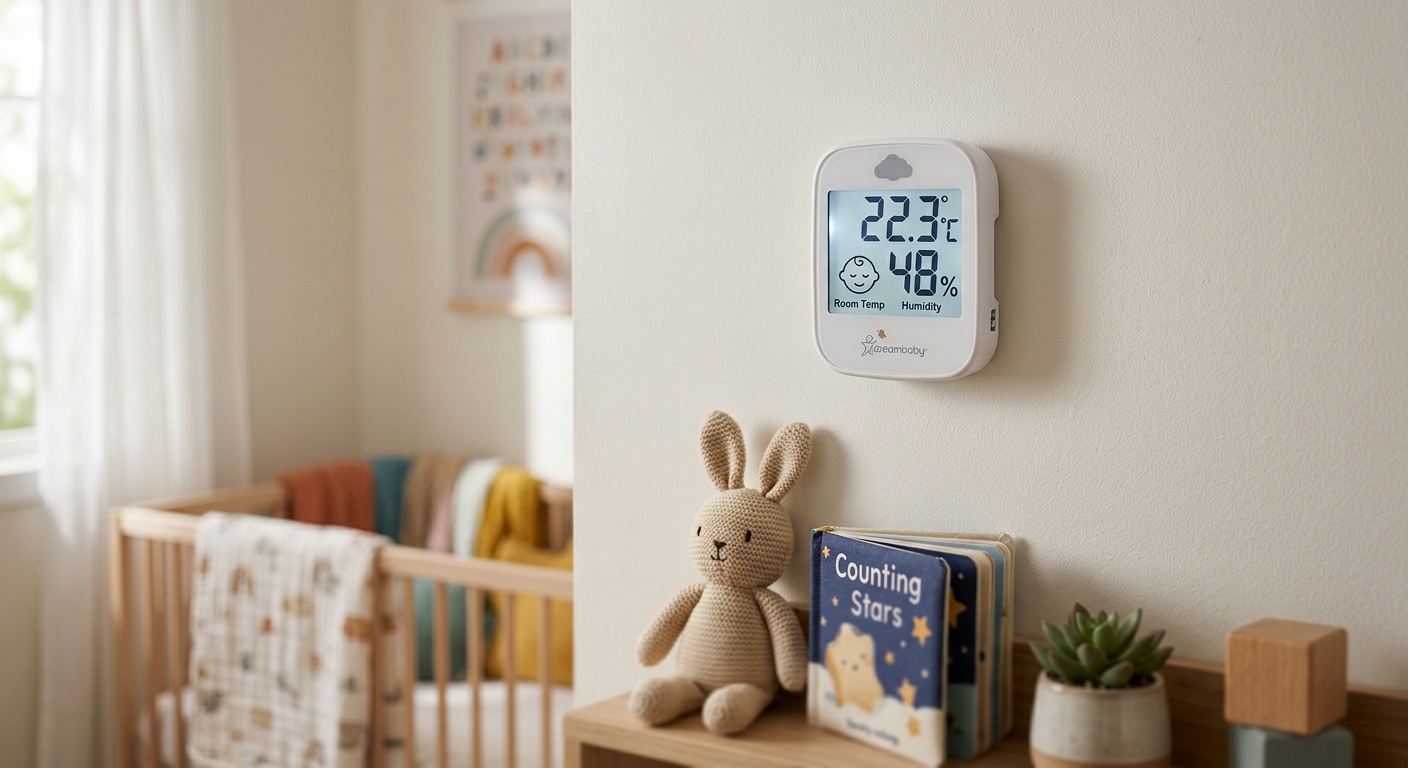
Smart nursery monitors have become far more accessible in 2026. Devices now routinely bundle temperature, humidity, CO2 levels, and VOC (volatile organic compound) detection into a single, app-connected unit. Brands like Owlet, Nanit, and Airthings have all expanded their environmental monitoring capabilities to give parents real-time nursery data directly on their phones.
Key monitoring tips:
- Place the sensor at crib level — not ceiling height. Hot air rises, so ceiling-mounted sensors can give misleading readings.
- Track humidity alongside temperature. The ideal nursery humidity range is 40–60%. Dry air below 30% can irritate nasal passages and worsen congestion in infants, while humidity above 65% can promote mold growth.
- Log temperature across a 24-hour cycle before making permanent setup decisions. Morning, afternoon, and nighttime readings can differ by 4–6°F in many homes.
- Use a dedicated room thermometer, not just your central HVAC’s display. As Maya and James discovered, these numbers can diverge significantly.
Quick scenario: Suppose your nursery reads 74°F at bedtime — just 2 degrees above the upper recommended limit. Your baby is in a light sleep sack over a onesie. Do you reach for the AC or open a window? The answer depends on your outdoor air quality, noise levels, and pollen counts — all variables that a smart home system can now factor in automatically if configured correctly.
AC Maintenance Essentials for Safe, Efficient Cooling
Why 2026 Is the Year to Get Serious About AC Upkeep
Summer 2025 was the third consecutive year in which U.S. average temperatures broke seasonal records in multiple regions. With energy costs continuing to climb — the U.S. Energy Information Administration reported a 7% average increase in residential cooling costs between 2024 and 2026 — the pressure to run an efficient, well-maintained AC system has never been higher.
An underperforming AC unit doesn’t just cost you money. In a nursery context, it’s a safety issue. A system struggling with clogged filters, low refrigerant, or failing components will cycle unpredictably, create humidity spikes, and push dust, allergens, and mold spores into exactly the environment your infant is breathing in 24/7.
Here’s your practical AC maintenance roadmap for 2026:
- Replace or clean air filters every 30–60 days during heavy cooling season. Homes with pets, infants, or allergy sufferers should lean toward the 30-day schedule. In 2026, HEPA-grade filters have become standard recommendations for nursery-adjacent HVAC systems.
- Schedule professional coil cleaning annually. Dirty evaporator and condenser coils reduce system efficiency by up to 30%, according to the Department of Energy. The best time to book? March or April — before summer demand spikes service wait times.
- Check and clear condensate drain lines every season. Blocked lines cause water backup, which leads to mold growth inside the unit — a serious concern for indoor air quality.
- Inspect refrigerant levels every 2 years (or if you notice reduced cooling performance). Low refrigerant doesn’t just decrease cooling capacity — it can cause the system to freeze up and shut down unexpectedly.
- Seal ductwork leaks. The EPA estimates that 20–30% of conditioned air is lost through leaky ducts in a typical home. In a two-story house with a nursery upstairs, this can mean the nursery runs significantly warmer than your thermostat target.
Pro Tip: Many utility companies in 2026 offer free or subsidized home energy audits that include HVAC inspection. These audits have expanded significantly following federal incentive programs renewed under the 2025 Residential Energy Efficiency Act. Check your local utility provider’s website — you may qualify for a no-cost assessment that identifies both safety and efficiency improvements.
Air Coolers vs. Air Conditioners in the Nursery
One of the most common questions parents search in 2026 centers on whether portable air coolers — evaporative units that use water rather than refrigerant — are a safe or appropriate alternative to traditional AC in a baby’s room. The question of whether is air cooler safe for babies involves a nuanced answer that depends on your climate, the unit’s placement, and how well you maintain it.
The short answer: evaporative coolers work well in dry climates (below 40% humidity) and can be a gentle, energy-efficient option. However, in humid regions like the southeastern U.S., they can actually raise indoor humidity to levels that promote mold and dust mites — both significant respiratory hazards for infants. If you use one, clean the water tank daily and monitor humidity levels closely.
Traditional air conditioners, while more expensive to operate, offer the advantage of dehumidification alongside cooling — making them the more versatile and generally safer choice for nursery environments across a wider range of climates.
Seasonal Home Comfort Tips: Room by Room
Effective home comfort isn’t a “set it and forget it” endeavor — it’s a seasonal discipline. Here’s how to adapt your approach across the calendar year, with particular attention to spaces that matter most.
Spring (March–May): Transition and Preparation
- Service your AC before the first heat wave hits. Book in February or early March to avoid the spring rush.
- Open windows during cooler morning hours (5–9 a.m.) to naturally ventilate the nursery — just monitor pollen counts if your baby has any respiratory sensitivities.
- Test your thermostat’s cooling function before you need it urgently. A malfunction discovered in April is far less stressful than one discovered during a June heat advisory.
- Swap heavy nursery curtains for lighter, UV-filtering alternatives that allow airflow while blocking heat gain.
Summer (June–August): Precision Cooling
- Run ceiling fans counterclockwise to push cooled air downward — this can make a room feel 4°F cooler without dropping the thermostat.
- Use blackout curtains on south- and west-facing windows between 12–5 p.m. to prevent solar heat gain.
- For nurseries, maintain a dedicated zone thermostat or supplemental cooling unit to ensure the room stays within the 68–72°F target even when the rest of the house runs warmer.
- Never place a portable AC unit or fan directly blowing on a baby’s crib. Indirect air circulation is the goal.
Fall (September–November): The Forgotten Season
- Fall is ideal for HVAC system cleaning and filter replacement before heating season begins.
- Use this window to reassess your nursery setup — temperature needs shift as outdoor conditions change and babies grow older.
- Seal window drafts early. A single poorly insulated window can drop nursery temperatures by 3–5°F on cold nights.
Winter (December–February): Safe Heating Practices
- Keep nursery temperatures no lower than 65°F at night — cold stress in infants increases metabolic demands and can disrupt sleep.
- Use a humidifier during heating season to counteract the drying effects of forced-air heat. Target 45–50% relative humidity.
- Never use space heaters in a nursery without tip-over and overheat protection features. Place them at least 3 feet from cribs and fabric surfaces.
- Check carbon monoxide detectors monthly — heating season is the highest-risk period for CO incidents.
Common Challenges and How to Overcome Them
Even with the best intentions and equipment, real-world home comfort throws curveballs. Here are three of the most common challenges families face in 2026 — and exactly how to handle them.
Challenge 1: Inconsistent Temperature Between Floors
Multi-story homes frequently experience a 5–8°F difference between ground and upper floors due to heat stratification. If your nursery is upstairs, it will almost always run warmer in summer. Solution: Install a mini-split system for the nursery zone, or use a smart vent system (like those from Flair or Keen) to redirect more conditioned air to upper-floor rooms automatically.
Challenge 2: AC That Cools Too Aggressively or Cycles Unpredictably
Short-cycling — when an AC unit turns on and off rapidly without completing a full cooling cycle — is often caused by an oversized unit or a refrigerant issue. It creates uncomfortable temperature swings and excessive humidity. Have a licensed HVAC technician assess system sizing and refrigerant charge. In new construction homes built in 2024–2026, oversized systems remain a surprisingly common installation error.
Challenge 3: Managing Air Quality Alongside Temperature
Parents often focus entirely on temperature and forget that air quality in a sealed, climate-controlled nursery can deteriorate. VOCs from new furniture, paint, and flooring, combined with recirculated air, can create an invisible indoor pollution problem. Solution: Run an air purifier with a HEPA and activated carbon filter continuously in the nursery, ventilate the room for 15–20 minutes daily when outdoor air quality permits, and choose low-VOC nursery furnishings.
Data at a Glance: Temperature Comfort Benchmarks
| Setting / Life Stage | Recommended Temp Range | Humidity Target | Key Consideration |
|---|---|---|---|
| Nursery (0–12 months) | 68°F – 72°F | 40–60% | SIDS prevention; no direct airflow on crib |
| Toddler Room (1–3 years) | 68°F – 74°F | 40–55% | Wider range acceptable; monitor activity level |
| Adult Bedroom (sleep) | 65°F – 68°F | 40–50% | Cooler temps support deeper REM sleep |
| Living / Common Areas | 70°F – 76°F | 40–60% | Balance comfort with energy cost |
| Home Office / Work Space | 70°F – 73°F | 40–55% | Productivity peaks at slightly cooler temps |
Nursery vs. Whole-Home Temperature: How Well Do Most Homes Measure Up?
Based on 2025 smart home sensor data aggregated by residential HVAC monitoring platforms, here’s how accurately homes maintain target nursery temperatures:
Homes That Hit Target Range (68–72°F) Consistently
Source: Aggregated smart home sensor data, 2025 residential HVAC monitoring reports
Frequently Asked Questions
What temperature is too hot for a baby’s nursery?
Any sustained temperature above 75°F (24°C) in a nursery is considered potentially unsafe for sleeping infants, particularly when combined with heavy clothing or swaddling. Temperatures above 78°F significantly increase the risk of overheating, which is a known SIDS risk factor. Always use a room-level thermometer — not just your home’s central thermostat — to verify the actual temperature at crib level. If you notice your baby is sweating, has flushed cheeks, or feels hot to the touch on the back of their neck, the room is too warm.
How often should I service my home AC unit in 2026?
Professional servicing once per year — ideally in spring before cooling season — is the baseline recommendation. However, homes with infants, pets, or allergy sufferers should consider a mid-season filter check and coil inspection every 6 months. If your system is more than 8 years old, an annual inspection becomes even more critical. The 2025 Residential Energy Efficiency Act created rebate programs in many states for upgrading to high-efficiency systems, so this may be an excellent year to evaluate whether replacement makes more economic sense than continued maintenance on an aging unit.
Can I use a ceiling fan in a baby’s nursery?
Yes — and research actually supports it. A 2023 study found that room air circulation from ceiling fans was associated with a 72% lower risk of SIDS, likely due to improved air exchange and reduced rebreathing of exhaled CO2. The key caveats: ensure the fan is securely mounted and in good mechanical condition, run it on a low speed setting to avoid direct strong airflow on the crib, and set the direction to counterclockwise in summer (to push cool air down) and clockwise in winter (to recirculate warm air from the ceiling). Never use a portable oscillating fan positioned directly at an infant.
Your Home Comfort Action Plan: Start Tonight
You now have a comprehensive, practical framework for managing nursery temperature, maintaining your AC system, and adapting to seasonal shifts. Here’s how to move from information to implementation — starting in the next 24 hours.
Step 1: Audit Your Nursery Temperature Right Now. Place a standalone thermometer at crib level tonight. Log the reading before bed, at 2 a.m. (if you’re up for a feeding), and at 7 a.m. You’ll have your first 24-hour temperature profile by tomorrow morning.
Step 2: Schedule Your AC Service This Week. If you haven’t had a professional HVAC inspection in the past 12 months, book one now — before summer 2026 demand drives up wait times and pricing. Check whether your utility provider offers any 2026 incentive programs for the visit.
Step 3: Assess Your Duct and Filter Status. Pull your current air filter and check its condition. If it’s gray, compressed, or you can’t remember the last time you changed it, replace it today. This is a 10-minute, $10–20 fix that can meaningfully improve both air quality and system efficiency.
Step 4: Map Your Home’s Microclimates. Walk through your home with your phone’s smart thermometer app (or an inexpensive handheld unit) and note temperature differences between rooms. Identify any zones — especially nursery, bedroom, and living areas — that diverge more than 3°F from your thermostat’s target.
Step 5: Create a Seasonal Maintenance Calendar. Block 30 minutes in your calendar for each seasonal transition (March, June, September, December) to run through your home comfort checklist: filter replacement, thermostat calibration, humidifier maintenance, and window/door seal inspection.
As smart home technology continues to evolve through 2026 and beyond, the gap between “comfortable enough” and “optimally comfortable and safe” will increasingly come down not to equipment, but to intentionality. The families who thrive are those who treat home climate as an active, ongoing practice — not a passive background condition.
So here’s the question worth sitting with tonight: Is your home’s climate working for your family’s wellbeing — or are you simply adapting to whatever your HVAC system happens to produce? The difference between those two realities is often just a few small, well-informed decisions away.