Cozy Bedroom Decorating Ideas for a Restful Sleep Sanctuary
Cozy Bedroom Decorating Ideas for a Restful Sleep Sanctuary
Reading time: 12 minutes
Ever stared at your bedroom ceiling at midnight, wondering why sleep feels so elusive? You’re not alone — and your room’s design might be the culprit. Research published in 2025 by the Sleep Foundation found that 67% of adults report their bedroom environment directly impacts sleep quality, yet fewer than one in three have intentionally designed their space with rest in mind.
Here’s the straight talk: A cozy bedroom isn’t about expensive renovations or following influencer aesthetics. It’s about strategic design decisions that work with your body’s natural sleep biology. This guide cuts through the noise to give you a clear, actionable roadmap for transforming your bedroom into a genuine sleep sanctuary.
Table of Contents
- Why Bedroom Design Directly Affects Sleep Quality
- Color Psychology: Choosing the Right Palette
- Lighting Layers That Signal Rest
- Textiles and Bedding: The Comfort Foundation
- Furniture Arrangement and Spatial Flow
- Scent, Sound, and Sensory Balance
- Decluttering as a Design Strategy
- Design Styles Compared
- Real Transformations: Case Studies
- FAQs
- Your Sleep Sanctuary Blueprint: Next Steps
Why Bedroom Design Directly Affects Sleep Quality
Your bedroom sends constant signals to your nervous system. Color, light, temperature, texture — every element either tells your brain “it’s safe to rest” or keeps it in low-grade alert mode. Sleep neuroscientist Dr. Jade Wu, writing in Behavioral Sleep Medicine in 2025, describes this as the “environmental cueing effect”: your room becomes a psychological anchor for either wakefulness or sleep depending on how it’s designed.
The numbers are striking. A 2025 survey by the American Academy of Sleep Medicine found:
- 72% of respondents felt more relaxed immediately upon entering a bedroom they considered “cozy”
- 54% reported falling asleep faster (within 15 minutes) in a well-designed sleep environment
- 48% experienced fewer nighttime awakenings when ambient light and sound were properly managed
In 2026, with remote work blending home and office boundaries more than ever, the bedroom has taken on new complexity. Many people now work, stream content, exercise, and sleep in the same 200–300 square feet. Intentional design has never been more critical — or more rewarding when done right.
The Sleep-Space Connection: What Neuroscience Tells Us
Your brain builds associative pathways. If you consistently use your bedroom for work emails and late-night scrolling, it begins to associate that space with alertness rather than sleep. Interior designers and sleep specialists alike now recommend what’s called “zone delineation” — creating visual, textural, and sensory cues that separate the “sleep zone” from everything else, even in small spaces.
Think of it like Pavlov’s bell, but for rest. The more consistently your room looks, smells, and feels like a place designed for sleep, the faster your nervous system learns to downshift when you enter it.
Color Psychology: Choosing the Right Palette
Color is one of the fastest, most affordable levers you can pull in bedroom design. The right hues slow heart rate, lower cortisol, and ease the brain into a pre-sleep state. The wrong ones do the opposite.
The Science Behind Sleep-Friendly Colors
Research from the Travelodge Color in the Bedroom Study (replicated and expanded in 2024) found that people sleeping in blue rooms averaged 7 hours 52 minutes of sleep per night — the most of any color group. Soft greens and muted lavenders followed closely, linked to calming the sympathetic nervous system.
Colors to approach carefully include:
- Bright red or orange — stimulating, raises energy levels and alertness
- Stark white — can create a clinical or sterile atmosphere that feels cold rather than cozy
- Saturated yellow — cheerful but mentally activating, better suited for kitchens
Pro Tip: You don’t need to repaint entire walls. Introduce calming colors through bedding, throw pillows, curtains, and art. This is called color layering, and it gives you flexibility without commitment.
2026 Trending Bedroom Palettes
This year’s leading interior design trends favor what Pantone and Dulux both describe as “grounded naturals” — warm taupes, clay tones, forest greens, and slate blues. These earthy, muted palettes create a cocoon-like atmosphere that aligns perfectly with sleep science. If you’re redecorating in 2026, this trend isn’t just aesthetically current — it’s biologically smart.
Lighting Layers That Signal Rest
Lighting is arguably the single most impactful environmental factor for sleep quality. Light suppresses melatonin production — your body’s sleep hormone — with blue-spectrum light being the most disruptive. A 2025 Harvard Medical School brief confirmed that even 10 minutes of bright light exposure before bed can delay melatonin onset by up to 90 minutes.
The solution isn’t darkness — it’s intentional layering.
Building Your Bedroom Lighting System
Effective bedroom lighting operates on three layers:
- Ambient Lighting — The base layer. Soft, warm overhead lighting (2700K–3000K color temperature) for general room use. Dimmer switches are essential here — they allow you to gradually decrease brightness as bedtime approaches, mimicking sunset cues.
- Task Lighting — Directional bedside lamps for reading or journaling. Opt for warm-toned bulbs with adjustable brightness. In 2026, smart bulbs that automatically shift to warmer spectrums after 8 PM are widely available under $30 — a genuinely worthwhile investment.
- Accent Lighting — The cozy layer. Fairy lights, salt lamps, LED candles, or low-lumen floor lamps tucked in corners. These create depth, warmth, and visual interest without flooding the room with alertness-triggering light.
Blackout Curtains: Don’t underestimate external light intrusion. A 2025 study in the journal Current Biology found that even dim light during sleep — like streetlamps through curtains — increased next-day cortisol levels by 15%. Quality blackout curtains are one of the highest-ROI investments in your sleep sanctuary.
Textiles and Bedding: The Comfort Foundation
Your bed is the centerpiece of the room — visually, functionally, and biologically. The right textiles don’t just look inviting; they regulate temperature, reduce friction, and signal luxury to your nervous system.
Thread Count vs. Fiber Type: What Actually Matters
The “higher thread count = better quality” myth persists, but textile experts have debunked it. A 400-thread-count sheet in 100% long-staple cotton (like Egyptian or Supima) will outlast and outperform a 1000-thread-count sheet made from short-staple or blended fibers. In 2026, bamboo-derived and eucalyptus (Tencel/Lyocell) fabrics have surged in popularity for their temperature-regulating and moisture-wicking properties — ideal for hot sleepers or those experiencing hormonal fluctuations.
Key bedding elements for a cozy sanctuary:
- Duvet or comforter — Choose fill power appropriate for your climate. Down alternative options have dramatically improved in quality since 2024 and offer hypoallergenic benefits.
- Weighted blankets — The 2025 market saw a 34% increase in weighted blanket sales, driven by growing evidence of their anxiety-reducing effects. 15–20 lbs is generally recommended for adults.
- Layering textures — Combine a crisp cotton sheet base with a plush fleece or knit throw. Visual and tactile layering makes a bed look instantly more inviting while adding functional warmth.
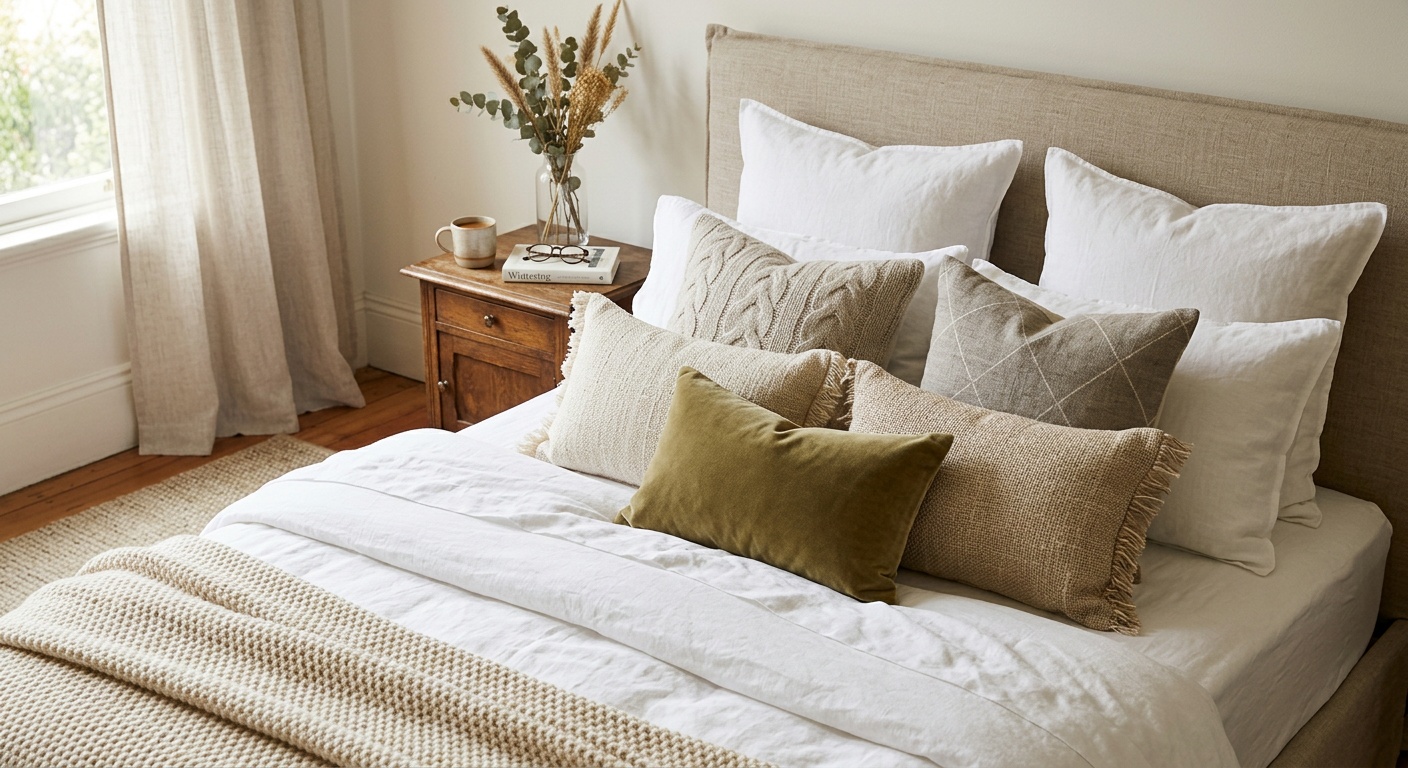
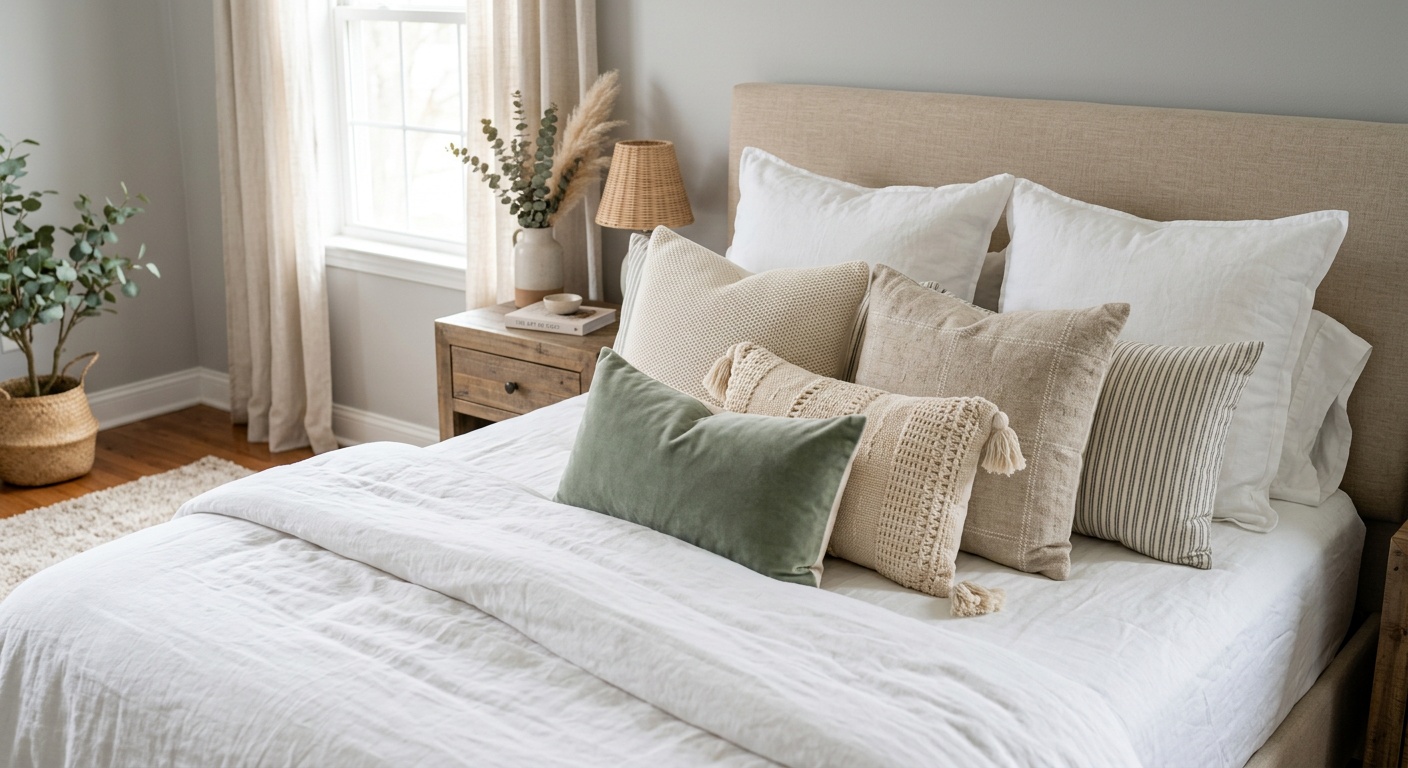
- Pillow variety — Mix sleeping pillows (ergonomically appropriate for your position) with 2–3 decorative pillows in complementary textures. This creates visual fullness without overwhelming the space.
Furniture Arrangement and Spatial Flow
How you position furniture shapes the room’s energy flow, air circulation, and how spacious or cramped the space feels — all of which affect psychological ease at bedtime.
The foundational principle: The bed should be the visual and functional anchor. In most rooms, this means placing it against the longest solid wall, centered, with clear walking paths on at least two sides. Feng shui practitioners and Western interior designers both converge on one point: sleeping with a clear sightline to the door (without being directly in front of it) reduces subconscious threat-monitoring during sleep.
Small Bedroom Solutions
In 2026, with urban apartment sizes continuing to shrink in major cities like New York, London, and Tokyo, small-space bedroom design is a mainstream challenge. Effective strategies include:
- Floating furniture — Wall-mounted nightstands and shelves free up floor space, making the room feel larger and easier to clean.
- Mirrors strategically placed — A large mirror on a side wall doubles perceived space without adding square footage. Avoid placing mirrors directly facing the bed, which some sleepers find psychologically unsettling.
- Multifunctional pieces — Storage ottomans, beds with built-in drawers, and benches with interior compartments reduce visual clutter while solving storage challenges simultaneously.
- Vertical space use — Floor-to-ceiling curtains (even on windows that don’t require them) draw the eye upward, making ceilings feel higher and rooms feel airier.
Scent, Sound, and Sensory Balance
A cozy bedroom engages all five senses. Most design advice focuses on visuals, but scent and sound are powerfully underutilized tools for creating a genuine sleep sanctuary.
Aromatherapy for Sleep: What Works in 2026
The evidence base for sleep-supportive scents has strengthened considerably. A 2025 meta-analysis in the Journal of Alternative and Complementary Medicine reviewed 30 studies and found the following aromatherapy interventions reliably improved sleep onset and quality:
- Lavender — The gold standard. Reduces anxiety, lowers heart rate, and shortened sleep onset time by an average of 12 minutes in clinical trials.
- Cedarwood — Contains cedrol, a compound with mild sedative properties. Increasingly popular in 2026 as part of the “forest bathing” wellness trend.
- Bergamot — Citrusy but calming; effective at reducing cortisol without the stimulating effects of other citrus scents.
- Chamomile — Classic and gentle; particularly effective for those with anxiety-related sleep disruption.
Delivery methods matter. Ultrasonic diffusers are preferred over heat diffusers, which can degrade essential oil compounds. Reed diffusers provide constant low-level scent — ideal for a bedroom. Avoid synthetic air fresheners, which often contain volatile organic compounds (VOCs) that can irritate airways during sleep.
Sound Design for Better Sleep
Silence isn’t always golden. For many people, complete silence amplifies minor sounds into disruptive intrusions. White noise machines, brown noise, and pink noise have all shown efficacy in sleep research. Brown noise — a deeper, richer frequency than white noise — ranked as the most-streamed sleep sound on Spotify and YouTube in 2025.
Nature sounds (rainfall, forest ambience, ocean waves) are particularly effective at reducing pre-sleep anxiety. In 2026, smart speakers and sleep-specific apps like Calm, Sleep Cycle, and Endel can be programmed to automatically reduce volume as you fall asleep — removing the need to get up to adjust settings.
Decluttering as a Design Strategy
Visual clutter isn’t just an aesthetic problem — it’s a documented sleep disruptor. A 2024 study at Saint Lawrence University found that women who described their bedrooms as “cluttered” had significantly higher cortisol levels and reported more sleep difficulties than those who described their space as “restful.” The effect was present regardless of actual room size.
The cozy paradox: maximalist decor can feel warm, but unmanaged clutter creates cognitive load. The distinction lies in intention. Every object in a sleep sanctuary should either serve a function or genuinely delight you. Anything else is visual noise that your brain must process — even while you’re trying to rest.
Practical declutter strategies:
- The nightstand audit — Limit to 5 items maximum: lamp, book or journal, water glass, phone charger, and one personal item. Everything else finds a drawer or leaves the room.
- Closed storage over open shelving — In bedrooms specifically, closed wardrobes and dressers outperform open shelving aesthetically and neurologically.
- The “one in, one out” rule — Each new bedroom item requires the removal of an existing one. This prevents gradual accumulation over time.
- Tech boundaries — Work devices, exercise equipment, and home office materials don’t belong in a sleep sanctuary. If your space requires them, conceal them behind closed doors or decorative screens.
Design Styles Compared: Which Is Right for Your Sleep Sanctuary?
Different design aesthetics create different sensory experiences. Here’s how the most popular 2026 bedroom styles stack up against key sleep-sanctuary criteria:
| Design Style | Cozy Factor | Clutter Risk | Sleep-Science Alignment | Budget Flexibility |
|---|---|---|---|---|
| Scandinavian/Nordic | High | Low | Excellent | High |
| Japandi (Japanese-Scandi Fusion) | Very High | Very Low | Excellent | Medium |
| Bohemian/Maximalist | Very High | High | Moderate | High |
| Modern Minimalist | Medium | Very Low | Good | Medium |
| Cottagecore/Biophilic | Very High | Medium | Very Good | High |
Sleep Sanctuary Factor Chart
Sleep Quality Improvement by Design Element (% of users reporting better sleep)
Source: Sleep Foundation Bedroom Environment Survey, 2025
Real Transformations: Case Studies
Case Study 1: The Overstimulated Studio Apartment
Maya, a 31-year-old UX designer in Chicago, shared her story in a 2025 Apartment Therapy feature. Her 380-square-foot studio had her desk, TV, exercise mat, and bed all within 10 feet of each other. She was averaging 5.5 hours of sleep and waking frequently throughout the night.
Her targeted interventions:
- Installed a tension rod and curtain divider between her work zone and sleep zone
- Replaced overhead fluorescent lighting with a warm-toned floor lamp and two bedside dimmers
- Added blackout Roman shades to her east-facing window
- Switched her bedding to eucalyptus sheets and a weighted blanket
- Relocated her laptop and monitor to a closet each evening as a “shutdown ritual”
Result: After six weeks, Maya reported averaging 7.2 hours of sleep. Her sleep tracker showed a 40% reduction in nighttime wake events. Total investment: under $400.
Case Study 2: The Master Bedroom Overhaul
David and Sandra, a couple in their mid-40s in Portland, Oregon, had a large master bedroom that felt more like a storage facility than a retreat. Mismatched furniture, three different clocks visible from the bed, a treadmill in the corner, and overhead lighting that stayed at full brightness until lights-out were the primary culprits.
Their renovation approach was systematic:
- Repainted walls in a muted sage green (Sherwin-Williams “Comfort Gray” with a green undertone)
- Moved the treadmill to a spare room and replaced it with a small reading chair and floor lamp
- Invested in matching linen bedding in warm ivory tones
- Added a smart lighting system with an automated evening “wind-down” program
- Incorporated five low-maintenance houseplants (snake plants and pothos) for biophilic texture
Result: Both reported significant improvements in perceived sleep quality within four weeks. Sandra, who had struggled with anxiety-related insomnia for two years, found the combination of plant life, scent diffuser (cedarwood and lavender blend), and decluttered visual field particularly impactful. Total renovation budget: $1,100.
Frequently Asked Questions
What is the best bedroom temperature for sleep, and how do I achieve it through design?
The optimal sleep temperature for most adults falls between 60–67°F (15.6–19.4°C), according to the National Sleep Foundation. From a design perspective, you can support this range without solely relying on HVAC by choosing breathable natural fiber bedding (cotton, bamboo, linen), installing a ceiling fan for airflow management, and using layerable textiles rather than a single heavy duvet. In 2026, smart thermostats with sleep-mode programming — like the Ecobee SmartThermostat Premium — can automatically adjust room temperature on a schedule aligned with your circadian rhythm, making temperature management a seamless design feature rather than an afterthought.
Can I create a cozy bedroom sanctuary on a tight budget?
Absolutely — and the good news is that the highest-impact changes are rarely the most expensive. Blackout curtains can be found for $25–$60 and deliver measurable sleep quality improvements. Repainting a single accent wall costs under $50 in materials. Decluttering is free. A basic essential oil diffuser runs $20–$40. The principle of strategic prioritization applies: identify your single biggest sleep disruptor (often light or noise) and address that first. A phased approach — improving one element per month — lets you build a genuine sanctuary without financial strain. Even $150–$200 invested thoughtfully in the right areas can produce dramatic results, as Maya’s case study demonstrates.
How do houseplants affect sleep quality in bedroom design?
Houseplants contribute to bedroom ambiance through both visual warmth and modest air quality benefits. The much-cited NASA Clean Air Study identified plants like snake plants, peace lilies, and pothos as mild air purifiers. While the direct air-quality impact in a residential bedroom is modest (you’d need many plants to significantly move the needle on VOC levels), the psychological and biophilic benefits are well-documented. A 2024 study in Urban Forestry & Urban Greening found that participants with plants in their bedrooms reported 18% lower stress levels at bedtime compared to those without. In design terms, plants add organic texture, color, and a living quality that contributes meaningfully to the cocoon-like atmosphere of a sleep sanctuary. Choose low-maintenance varieties — caring for struggling plants creates stress, not calm.
Your Sleep Sanctuary Blueprint: Next Steps
Transforming your bedroom into a genuine sleep sanctuary isn’t about perfection — it’s about intentional, progressive improvement. Here’s your action-oriented roadmap:
- This week — The Light Audit: Spend one evening identifying every light source in your bedroom. Note which ones are active during your wind-down window (the two hours before bed). Order blackout curtains if needed. Swap any cool-spectrum bulbs for warm-toned (2700K) alternatives. This single step addresses the #1 biological sleep disruptor.
- Week two — The Textile Upgrade: Evaluate your bedding honestly. Are your sheets breathable? Is your duvet appropriate for your body temperature? Make one quality upgrade — even just new pillowcases in a natural fiber — and notice how it shifts your relationship with your bed.
- Week three — The Declutter Session: Set a 30-minute timer and remove everything from your bedroom that doesn’t serve sleep, rest, or intimate connection. Box it up, store it elsewhere, and sleep in your newly cleared space for a week before deciding what, if anything, to bring back.
- Week four — Scent and Sound: Introduce one aromatherapy element (a diffuser, linen spray, or reed diffuser) and experiment with a sound environment. Try brown noise, rainfall sounds, or white noise for a week and assess its impact on how quickly you fall asleep.
- Month two and beyond — Color and Style: Once the functional foundations are solid, layer in aesthetic upgrades aligned with a cohesive design style. This is where color palettes, art, and decorative textiles come in — the “delight layer” that makes the space feel uniquely yours.
In 2026, the intersection of sleep science and interior design is becoming a recognized wellness discipline — sleep-focused interior designers and “circadian design” consultants are a growing professional niche. The broader cultural shift toward treating sleep as foundational health behavior means bedroom design is finally getting the serious attention it deserves.
Here’s the question worth sitting with: If you spent the same time, money, and attention on your bedroom that you spend optimizing your morning routine or workout regimen, what would your sleep — and your life — look like in six months? Your bedroom is the environment where you spend a third of your entire life. Designing it with intention isn’t indulgent. It’s essential.